
Milano-Cortina 2026 Winter Olympic Opening Ceremony at San Siro Stadium
Torch Relay in the historic city centre – Ice Hockey Arena
On Friday 6 February at 8 p.m., the Winter Olympic Games were officially opened at the iconic San Siro Stadium — a venue that has witnessed legendary football moments and has now hosted a global celebration of sport attended by more than 65,000 spectators.
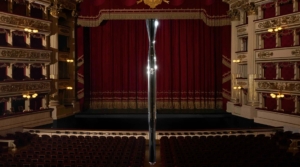
The Milano-Cortina 2026 Olympic torch, named “Essential” and designed by Carlo Ratti
During the day, the city of Milan was unusually quiet. Many locals had been instructed to work from home, leaving the streets uncharacteristically empty as the Olympic torch passed through the city. Named “Essential”, the torch was designed by Carlo Ratti in accordance with Mies van der Rohe’s principle of “less is more.” It is made of sustainable lightweight metal that reflects its surroundings, transforming its surface into a narrative device. As the torch travels, it constantly changes colour — whether on the snow, by the sea, on the water, amidst greenery or along the streets of Milan.
The one I captured was carried by the Italian swimming champion Federica Pellegrini. Click on the link to watch the video.
It is the first rechargeable Olympic torch: the same torch can be reused by refilling it with biofuel, reducing the total number of torches required by a factor of ten.
A powerful and emotional night for the city and for Italy, where tradition, innovation and international spirit came together on a truly unforgettable stage, carefully designed by the renowned Italian creative director Marco Balich. The opening ceremony marked the official start of the 2026 Winter Olympics — he first Games in Olympic history not to take place in a single location. Instead, the competitions are spread across four main clusters in northern Italy, with two primary hubs in Milan, the capital of Lombardy and Cortina d’Ampezzo in the Veneto region. The celebration at San Siro was, in fact, one of four concurrent events, also held in Cortina, Livigno and Predazzo.
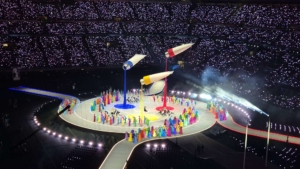
Giant paint tubes spilling cascading swathes of fabric across the stage
A tribute to Milan’s and Italy’s artistic heritage was conveyed through the striking image of giant paint tubes spilling cascading swathes of fabric across the stage. The fabric unfurled in the three primary colours — blue, yellow and red — the fundamental hues from which all others are derived.
What is usually a football pitch was transformed into a vast theatrical canvas, animated by a succession of tributes: to art and sculpture, honouring the Neoclassical Venetian master Antonio Canova; to dance, with performers from the Accademia del Teatro alla Scala evoking the fluid, dynamic movements of winter sports; to industry and creativity, represented by performers disguised as human-sized Bialetti coffee makers;
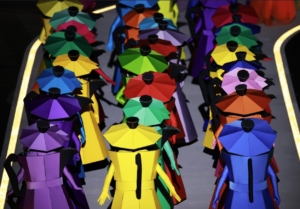
Performers disguised as human-sized Bialetti coffee makers
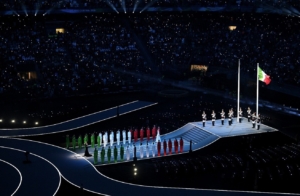
The Lombard top model Vittoria Ceretti carries the Italian flag. All models wear Giorgio Armani outfits in the colours of the Italian flag
to fashion, embodied by the Lombard top model Vittoria Ceretti carrying the Italian flag, surrounded by models wearing Giorgio Armani outfits forming the colours of the Italian flag; and to theatre and cinema, marked by the appearance of The White Lotus star Sabrina Impacciatore.
Providing comic relief, three performers wearing enlarged bobble-head masks in the likeness of Giuseppe Verdi, Giacomo Puccini and Gioachino Rossini whipped up the crowd, while also serving a practical purpose: distracting the cameras as sets and backdrops were changed around them. The pageantry then made way for the evening’s most anticipated international guest, Mariah Carey, who performed a bilingual medley, moving from Domenico Modugno’s Nel blu, dipinto di blu to her own anthem Nothing Is Impossible.
The ceremony’s closing performances were perhaps its most moving. Dedicated to peace, the Italian tenor Andrea Bocelli delivered a solemn rendition of Puccini’s Nessun Dorma, followed by the Italian rapper Ghali who — accompanied by a dance troupe of children and teenagers — recited a poem by Gianni Rodari on resisting the madness of war.

Performers create a giant dove, a symbol of peace
The evening culminated in the lighting of the Olympic cauldrons — plural, for the first time — as twin structures were unveiled simultaneously at Milan’s Arco della Pace (Peace Arch) and in Cortina d’Ampezzo. Created by Marco Balich, the Milano Cortina 2026 cauldrons pay tribute to the sun as the primary source of life and energy, from which the Olympic flame originates. The cauldrons take the form of two spheres whose dynamic opening and closing movements mirror the natural cycle of the sun as it rises and sets.
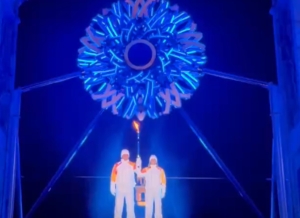
Torchbearers Alberto Tomba and Deborah Compagnoni stand beneath the Olympic cauldron, which is still unlit
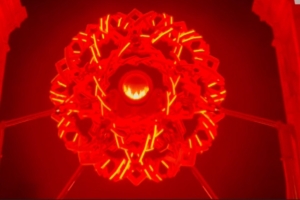
Milano-Cortina 2026 Winter Olympic cauldron

Codex Atlanticus, f. 700 recto
The intricate design of the cauldrons is also a homage to Leonardo da Vinci, who lived and worked in Milan for more than twenty years. It references the complex knot geometries that recur in many of his works and appear in preparatory studies and on pages of the Codex Atlanticus, housed in Milan. The knot constitutes a coded nominal allusion of an onomastic nature: it functions both as a topographical reference to his native Vinci and as a learned evocation of his own family name, in keeping with Leonardo’s fondness for rebuses and anagrams, since “vinci” can also signify “bonds” or “ties”, and thus knots or interlacings. It is, however, the grand allegorical decoration of the Sala delle Asse,

Leonardo da Vinci’s grand allegorical decoration of the Sala delle Asse, located on the ground floor of the north-eastern tower of the Castello Sforzesco
on the ground floor of the north-eastern tower of the Castello Sforzesco — begun in 1498 with substantial assistance from workshop collaborators and left unfinished at the end of 1499 following the capitulation of the Duchy of Milan during the French invasion — that demonstrates the most scenographic and spectacular deployment of knots and interlacings. These form part of a highly celebratory iconological programme extolling the political virtues of Ludovico il Moro, whose presence is alluded to through the luxuriant branches of mulberry trees (gelsi-mori), which weave and intertwine with the rope knots.
Ice Hockey Arena
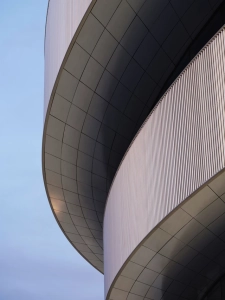
Ice Hockey Arena designed by the internationally renowned practice David Chipperfield Architects
Commissioned for the Milano Cortina Winter Olympic Games, the new Ice Hockey Arena — designed by David Chipperfield Architects — forms the centrepiece of the wider regeneration of Milano Santa Giulia, an emerging district in the city’s south-east area. Strategically positioned a few kilometres from the historic core and integrated into the high-speed rail and motorway infrastructure, the arena operates as both a sporting venue and an urban catalyst.
Construction commenced in 2021. The architectural concept offers a contemporary abstraction of the Roman amphitheatre typology, reinterpreting its civic monumentality through a restrained and rigorously ordered formal language. With a seating capacity of up to 16,000, the building balances large-scale event functionality with a carefully choreographed spatial sequence.
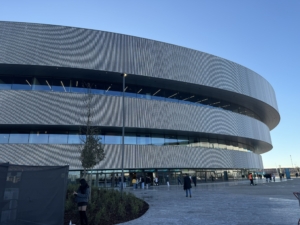
Ice Hockey Arena designed by the internationally renowned practice David Chipperfield Architects
The approach is deliberately processional: visitors ascend a generous stairway to a raised podium that effectively becomes an urban plinth, mediating between the scale of the surrounding development and the arena’s volumetric presence. Resting on this podium, the arena’s envelope is articulated as three horizontally layered rings that appear to hover in tensioned equilibrium. These aluminium bands, integrated with linear LED illumination, dematerialise the mass of the structure after dark, generating a kinetic visual effect that softens the building’s tectonic solidity and introduces a sense of rhythm and permeability.
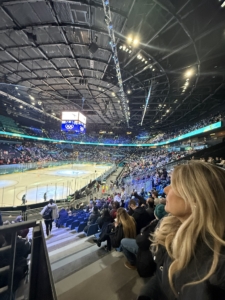
Ice Hockey Arena, Barbara Quarello, February 5, 2026
Internally, the arena is organised across two primary seating tiers above the parterre, with a further upper level accommodating hospitality lounges and sky boxes. The spatial configuration prioritises visibility, circulation efficiency and acoustic performance, while maintaining flexibility for post-Olympic use.
In its legacy phase, the arena is designed to function as a multi-purpose venue, hosting concerts, festivals and major sporting events. As such, it is conceived not merely as Olympic infrastructure, but as a durable civic landmark intended to anchor the district’s long-term social and cultural life.
For further information, please contact me.


