
Discover Paul Troubetzkoy
Master Sculptor of the Belle Époque
Exclusive Retrospective | Until 28 June 2026
Milan, Galleria d’Arte Moderna (GAM)
The exhibition traces the extraordinary work of Paul Troubetzkoy (Intra 1866 – Pallanza 1938), a cosmopolitan sculptor and the son of the Russian diplomatic prince Pierre and the American opera singer Ada Winans. Born on the shores of Lake Maggiore and trained in Italy, Parisian by adoption, and renowned in the United States, Troubetzkoy established himself among the most refined portraitists of the Belle Époque, becoming a key figure on the international art scene and a reference point for the high society of his time. He was always called Paolo in Milan and across Italy, but internationally he became famous as Paul.

Albert Harlingue (1879–1963), Paul Troubetzkoy in his Paris Studio with his wolves, 1909–1914,
photograph, Paris, Bibliothèque historique de la Ville de Paris, Roger-Viollet Collections
Eighty works of art
The exhibition brings together eighty works, including sculptures and paintings, from major Italian, European, British, and American collections. Organised into five thematic and chronological sections, it traces Troubetzkoy’s personal and artistic journey: from his early successes in Milan, where he immersed himself in the Scapigliatura circles, to his international acclaim following the victory of prestigious competitions—such as the commission for the monumental equestrian statue of Tsar Alexander III in St. Petersburg—through his move to Paris, and finally to his participation in major American exhibitions.
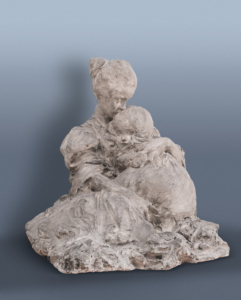
Paul Troubetzkoy, Maternità, 1898, plaster, Paris, Musée du Petit Palais
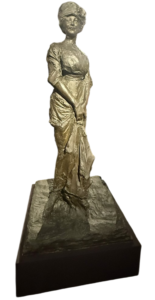
Paul Troubetzkoy, My wife (Elin Troubetzkoy), 1911, bronze, life-size. Rome, Galleria Nazionale d’Arte Moderna e Contemporanea

Paul Troubetzkoy, Elin Troubetzkoy Nude, plaster, Verbania, Museo del Paesaggio
Portraitist of the elite
Known for his exceptional talent as a portraitist, Troubetzkoy was sought after by the cosmopolitan elite, celebrities, the Parisian jet set, and even the first stars of American cinema. His extraordinary life was marked by decisive encounters and friendships with prominent artists and writers such as Lev Tolstoj, George Bernard Shaw, Giovanni Segantini,

Paul Troubetzkoy, Giovanni Segantini, 1896, bronze, Verbania, Museo del Paesaggio. A masterful portrait capturing the spirit of Segantini
Joaquín Sorolla, and Giovanni Boldini.
The Modern and sensitive side
The portraits that earned him his fame capture the spirit of an entire era, while the exhibition also highlights his more sensitive and modern side through a moving body of animalier sculpture, a concrete expression of the vegetarianism he advocated, shared with his friends Lev Tolstoy and George Bernard Shaw. His stylistic signature—immediately recognisable—shows him as an excellent modeller, working the material with light, delicate touches that, in bronze castings, capture and make the light vibrate across the metal’s surface. This approach clearly engages with the question of impressionism in sculpture. Troubetzkoy’s ability to convey the fluidity of bodies, the energy of movement, and the strength of character places his work squarely at the intersection of the late 19th and early 20th centuries.

Paul Troubetzkoy, girl seated with dog, 1906, plaster, bronze patina, Verbania, Museo del Paesaggio

Paul Troubetzkoy, How can you eat me? 1912, bronze, Detroit, Detroit Institute of Arts

Paul Troubetzkoy, Two Pekinese dogs seated, plaster, Verbania, Museo del Paesaggio
Celebrating a rediscovered artist
Thanks to the exceptional loans granted by the Museo del Paesaggio in Verbania (Lake Maggiore), custodian of his studio archive, this exhibition finally offers the opportunity to celebrate an artist who remained long overlooked, despite enjoying considerable fame during his lifetime.
Milan and the Galleria d’Arte Moderna
The exhibition comes to Milan at the Galleria d’Arte Moderna (GAM) following its showing at the Musée d’Orsay in Paris. Milan—the city where Troubetzkoy lived and refined his style—was the scene of his earliest successes. The GAM not only preserves a substantial body of his works, but also a rich collection of paintings and sculptures from the Milanese Scapigliatura movement, which played a major role in his artistic formation.
For further information, please contact me.


