
Palazzo Litta and the elegance of the Barrocchetto Lombardo
Palazzo Litta stands as one of Milan’s most refined architectural treasures, offering a perfect introduction to a style that is uniquely local: the Barrocchetto Lombardo.
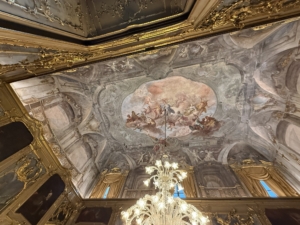
The ceiling of the Sala degli Specchi, Palazzo Litta’s magnificent ballroom
Emerging in Milan and Lombardy in the early 18th century, the Barrocchetto Lombardo is a more intimate, measured evolution of Baroque. Unlike the dramatic grandeur of Roman Baroque, this style favours elegance over excess, balance over theatricality. It speaks softly—but with sophistication—and was created for aristocratic palaces and refined interiors rather than grand churches or public monuments.

The Honour Courtyard of Palazzo Litta
At Palazzo Litta, this aesthetic is immediately apparent. The architecturecombines harmonious proportions with delicate decorative details, while interiors are enriched with graceful stuccoes, frescoes, and subtle illusions of space.
Everything is designed to impress without overwhelming, reflecting the Milanese aristocracy’s taste for cultivated discretion rather than ostentation.
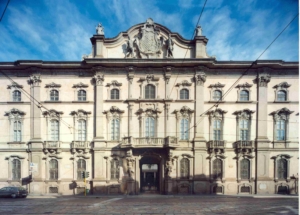
Palazzo Litta’s façade
The Barrocchetto Lombardo is a style shaped by Milan itself: a city of intellect, craftsmanship, and quiet power. It mirrors a society that valued cultural refinement, private salons, and artistic excellence over spectacle. Visiting Palazzo Litta is not simply entering a palace—it is stepping into a moment when Milan defined its own language of beauty, one that remains timeless, elegant, and deeply rooted in place.
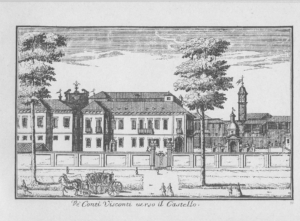
The back of Palazzo Litta in 1745 ca.
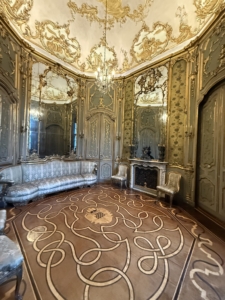
Palazzo Litta’s boudoir
The boudoir and the so-called Mirror Hall have remained untouched by time, preserving the intimate elegance of Palazzo Litta. The grand Ballroom, or Sala degli Specchi, on the other hand, was the stage for some of Milan’s most magnificent celebrations. Imagine the splendour in 1649, when Mariana of Austria, Archduchess of Austria, passed through Milan on her journey to Madrid to marry King Philip IV of Spain. In 1665, the palace welcomed Margaret Theresa of Spain, the bride of Emperor Leopold I, with festivities that dazzled the city.
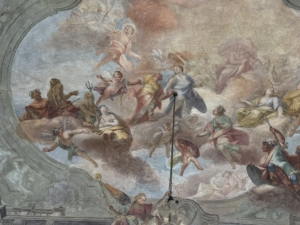
The ceiling painted by Giovanni Antonio Cucchi
Over the decades, these halls witnessed the footsteps of Europe’s most influential figures: Elisabeth Christine of Brunswick, Maria Theresa of Austria, and Eugène de Beauharnais, Viceroy of the Kingdom of Italy. At the height of history’s turning point, even Napoleon himself crossed these thresholds.
Palazzo Litta was not merely a noble residence; it was a living theatre of European history, where alliances were celebrated, power was displayed, and Milan stood at the crossroads of empires.
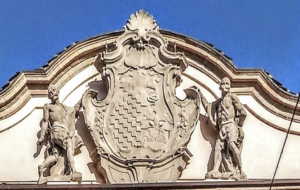
The coat of arms of the Litta family at the top of the façade
At the top of the façade, two Moors hold the family crest, a simple yet meaningful black-and-gold checkerboard. The design may appear straightforward, but it carries rich symbolism: the checkerboard represents the skill and cleverness with which the Litta family amassed their fortune; gold signifies their wealth, while black reflects their loyalty to the city of Milan.
Other heraldic symbols can also be seen: the white-and-blue lozenge denotes a branch of the Borromeo family; the eagle represents the Arese family—sometimes depicted as a black eagle with a crown, or simply with outstretched wings; and finally, the emblem of the Visconti family completes this tableau of Milanese nobility.

The coat of arms of the Litta family
For further information, please contact me.


