
The Brueghels: the origins of painting genres in Europe
From 29 September 2026 to 31 January 2027
Milan, Palazzo Reale
Today, Milan welcomes the first major exhibition devoted to the Brueghel family, a true artistic dynasty. Fathers and sons, workshops, journeys, commissions and family alliances unfold across the sixteenth century, a period marked by profound religious and political transformation. From Antwerp to Brussels, Rome, Milan and Prague, their story is intertwined with the Protestant Reformation, the Counter-Reformation, Spanish rule in the Netherlands and the emergence of the Flemish art market.
More than 70 works, including paintings, drawings and prints.
The exhibition begins with Pieter Bruegel the Elder (c. 1525/1530, Breda – Brussels, 5 September 1569), patriarch of the family and the originator of the ‘Brueghel’ name as an artistic brand — a legacy developed above all by his son Pieter Brueghel the Younger and, subsequently, by Jan Brueghel the Elder and his son Jan Brueghel the Younger.
Jan Brueghel the Elder (Brussels, 1568 – Antwerp, 12 January 1625) emerges as a central figure: a cosmopolitan artist and the younger son who absorbed the Italian manner, securing prestigious commissions, most notably from Cardinal Federico Borromeo, Archbishop of Milan and one of the earliest great collectors of Flemish painting in Italy. Milan thus established itself, in the seventeenth century, as one of the key centres for the dissemination of new Flemish pictorial genres across Europe. The exhibition also traces the spread of the Brueghel phenomenon throughout the continent, from the Habsburg court in Prague to the prosperous mercantile cities of the Low Countries, including Antwerp, Amsterdam and Haarlem.
This is the third exhibition in a trilogy curated by Bernard Aikema, following Albrecht Dürer in 2018 and Hieronymus Bosch in 2023. Together, the exhibitions illuminate a crucial period in European cultural history: the Renaissance and the profound transformation of artistic language that accompanied it.
The exhibition ultimately places the ‘Brueghel phenomenon’ within its broader historical context: an age of extraordinary economic, social and cultural ferment that witnessed the emergence of the modern genres of painting. Enriched by works by the Italian masters of the Bassano family workshop, the exhibition reveals how the ‘Brueghel brand’ helped lay the foundations for the landscape, battle scene, still life and genre painting that would flourish throughout seventeenth-century Europe.
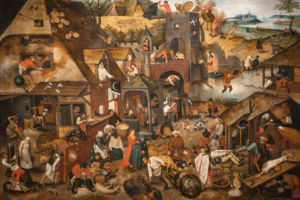
Pieter Brueghel the Younger
The Proverbs, 1606-1607 oil on panel
Stadsmuseum, Lier
Among the most emblematic works of the Brueghel tradition is The Proverbs (1607), painted by Pieter Brueghel the Younger after an invention by his father, Pieter Bruegel the Elder, dating from 1559. It offers a remarkable example of the dense and layered pictorial language for which the family became renowned.
The painting brings together, within a single teeming scene, a multitude of episodes, each corresponding to a proverb or popular expression from Flemish culture. More than a hundred proverbs are woven into a vivid and chaotic portrayal of humanity, offering an ironic and at times bitter reflection on everyday life, human folly and the weaknesses of human nature.
Its learned connection with the Erasmian tradition of the Adagia Collectanea — Erasmus of Rotterdam’s celebrated collection of proverbs, first published in 1503 and comprising more than 800 sayings — reveals the remarkable cultural complexity underlying this apparently straightforward visual repertoire.
The work belongs firmly to the great tradition of Flemish landscape painting, of which the Brueghels were among the foremost interpreters. Landscape is no longer merely a backdrop: it becomes an autonomous narrative space, capable of accommodating and organising a multitude of scenes, characters and meanings.
In this sense, The Proverbs stands as a key work for understanding the emergence of a new pictorial sensibility, in which nature and human life merge into a richly orchestrated, collective narrative.
For further information, please contact me.

